Read time: 3 minutes
A force-displacement curve is one of the most effective ways to evaluate the mechanical performance of a tactile dome switch. This curve visually represents how much force is required to actuate a switch and the amount of travel the switch undergoes from its open to closed position. By analyzing the curve, engineers can better understand switch feel, performance, and long-term reliability.
What Does a Force-Displacement Curve Show?
At its core, a force-displacement curve illustrates two primary characteristics:
- Actuation Force – The amount of force needed to collapse the dome and close the electrical circuit.
- Travel Distance – The displacement or movement of the dome from its resting (open) position to its actuated (closed) position.
In addition to these basics, the curve can also provide insight into other key switch parameters defined in ASTM F2592, such as:
- Tactile Ratio – A measure of the sharpness and feel of the switch response.
- Return Force – The amount of force with which the dome returns to its original state.
- Peak and Activation Points – Indicating where force builds, collapses, and resets.
Force-Displacement in Dome Switches
Since tactile domes are momentary contact switches, the top of the force-displacement curve corresponds to the peak force required for the dome to collapse. At that moment, the center of the dome makes contact with the underlying PCB or flex circuit, completing the circuit.
When force is released, the dome “snaps back” to its resting state. Some domes, however, are designed to be bi-stable—meaning they remain in a collapsed position until additional force is applied to reset them. This makes force-displacement testing critical for both standard tactile domes and specialty switch designs.
Why Analyzing Force-Displacement Matters
Accurate measurement of a dome switch’s force-displacement curve ensures that:
- User experience is consistent – A crisp, repeatable tactile feel builds user confidence.
- Switch performance meets spec – Measured values can be verified against ASTM or internal requirements.
- Lifecycle requirements are validated – Force and return force must hold steady over millions of actuations.
- Design trade-offs are optimized – Engineers can balance tactile ratio, actuation force, and durability depending on the end application.
For industries like medical devices, automotive, and industrial controls, where input reliability is mission-critical, force-displacement analysis is a key part of the design and validation process.
Tools for Measuring Force-Displacement
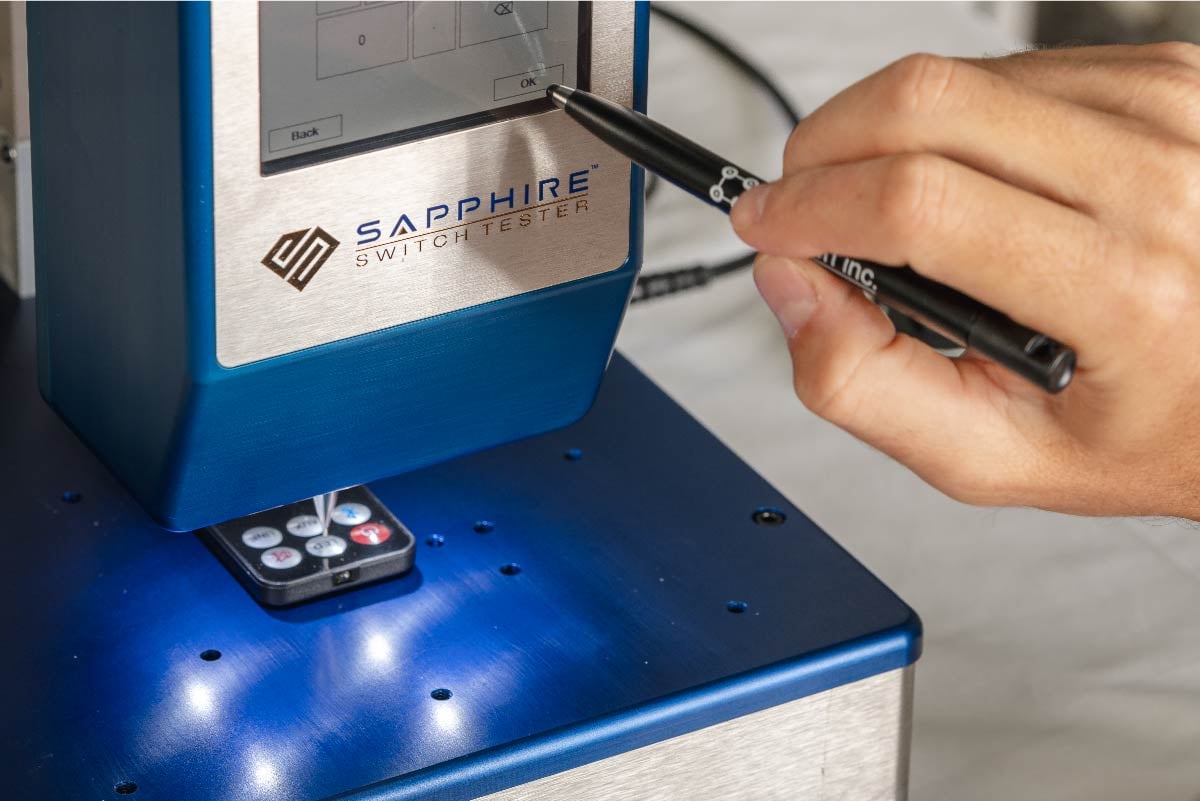
Snaptron offers the Sapphire Switch Tester, a dedicated force-displacement test machine for tactile domes. The Sapphire enables engineers to:
- Measure actuation force, return force, tactile ratio, and travel in real time.
- Ensure compliance with ASTM F2592 standards.
- Validate switch performance during quality control and production runs.
- Fine-tune switch feel for optimal user interface design.
By using a dedicated tester, you can confirm that your dome switches not only meet performance requirements but also deliver a consistent user experience throughout the product lifecycle.
Understanding and analyzing the force-displacement curve of a dome switch is essential for engineers working on high-performance keypads, medical devices, and rugged user interfaces. This testing provides the data you need to optimize tactile feel, durability, and compliance—while reducing costly redesigns.
The Sapphire Switch Tester makes this process simple, accurate, and repeatable. If you’re looking to validate your design or ensure production quality, our engineering team can help you select the right dome and provide force-displacement testing support.
Contact us today to learn more about force-displacement testing and how to enhance your tactile dome switch design.