Read time: 6 minutes
Adhesives are often overlooked in product design, yet they play a critical role in the performance, longevity, and reliability of dome switch assemblies. Selecting the right adhesive isn’t just about “what sticks”—it’s about ensuring bond integrity under mechanical stress, environmental exposure, and high life-cycle demands.
This guide distills decades of practical engineering knowledge and testing data into a reference for engineers evaluating adhesives in dome arrays and switch assemblies.

Why Adhesive Selection for Dome Switches Matters
The adhesive layer is the unsung hero in dome switch design. It not only bonds components together but also determines whether a switch can withstand millions of actuations, harsh climates, and demanding user environments. A poor adhesive choice may compromise tactile response, allow contamination ingress, or even cause premature product failure.
Adhesives directly influence:
- Reliability: Poor-quality adhesives can harden, crack, or delaminate over time, compromising their effectiveness.
- Life-cycle Performance: Dome switches often exceed 10 million actuations; the adhesive layer must endure the same.
- Environmental Resistance: Adhesives must withstand extreme temperatures, humidity, vibration, and chemical exposure.
- User Experience: The wrong adhesive-film combination can preload a dome, reducing tactile feedback or making the switch unresponsive.

Common Adhesive Systems in Dome Switches
Not all adhesives are created equal. In dome applications, only a few systems deliver the balance of performance, cost, and reliability needed.
| Adhesive Type | Typical Backing Film | Properties | Use Cases |
| Acrylic (pressure-sensitive) | Polyester (PET) | Long-term stability, does not over-harden, excellent chemical resistance | Standard choice for most dome arrays |
| Silicone | Polyimide | Exceptional temperature resistance (up to ~500°C), ESD protection, stable in niche environments | Specialty use in medical, aerospace, or defense where extreme resistance is required |
| Rubber-based | Varies | High tack but poor long-term and chemical resistance | Not suitable for dome applications |
Most dome switch manufacturers standardize on acrylic adhesives with polyester films, thanks to their proven reliability and versatility. Specialty systems, such as polyimide/silicone, should only be used when operating environments necessitate their use.
Selection Criteria: Balancing Film and Adhesive
Choosing the right adhesive system is about striking a balance between dome force, film flexibility, and bond area. Engineers should evaluate both adhesive aggressiveness and film thickness before finalizing a design to ensure optimal performance.
Bond Strength & Area
- High dome-count arrays reduce available bond area → require more aggressive adhesives.
- Low dome-count arrays allow less aggressive adhesives since more surface area is available for bonding.
Film Thickness & Rigidity
- Thicker films (≥0.05 mm) → More rigid, harder to conform, risk of preloading domes.
- Thinner films (0.025 mm PET with 0.025 mm acrylic) → Flexible, ideal for low-force domes.
Rule of thumb: Avoid rigid films over low-force domes—they mask tactile response.
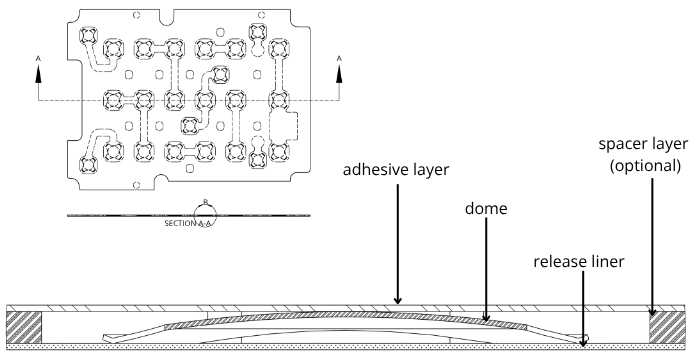
Spacer Layer Height
Spacer layers determine actuation performance. A good rule is:
- The spacer thickness should not exceed 50% of the dome height.
- Example: A 0.5 mm dome requires a spacer of ≤0.25 mm.
- If the spacer is too tall, the polyester film cannot flex enough to make contact, like a trampoline with legs that are too long.

Environmental Factors to Consider
Real-world environments often push adhesives to their limits. Engineers should anticipate operating conditions and select materials that can withstand them.
- Temperature:
- Acrylic/polyester stable from –40°C to ~150°C.
- Polyimide/silicone systems can withstand temperatures up to ~500°C.
- Humidity: Stable once applied; liners may absorb humidity before use.
- Chemicals: Acrylic and silicone resist most solvents and cleaners; avoid rubber-based adhesives entirely.
- UV Exposure: PET is vulnerable to UV radiation; always pair it with an external overlay or shield.
- Vibration & Shock: Proper venting and sealing are critical to prevent delamination in high-shock environments.
Adhesive Testing and Validation
Testing is the only way to validate adhesive performance for a given application. While many test methods exist, dome switches are most affected by peel strength.
- Peel Strength (most relevant): Measures resistance to lifting from a bonded surface.
- Tensile Shear: Evaluates sliding failure under stress.
- Cleavage & Tensile Tests: Used in broader adhesive testing, less common in dome switches.
By focusing on peel strength testing, manufacturers can predict how an adhesive will perform under repeated actuation and long-term environmental stress.
Cure Time and Handling Considerations
Engineers often overlook the cure time, but it has a direct impact on performance and assembly processes.
- Acrylic adhesives: Reach ~70% of bond strength within 24 hours and full cure at 72 hours.
- High-tack adhesives: Provide immediate adhesion but are non-repositionable.
This distinction is particularly important for assembly lines: acrylic adhesives allow for repositioning if misaligned, whereas high-tack systems require a perfect first placement.
Common Failure Modes in Adhesive Applications
The domes themselves rarely cause failures in dome switches—most occur at the adhesive layer. The most common issues include:
- Insufficient Bond Area: Allows contamination, moisture ingress, and delamination.
- Improper Film Selection: Overly rigid films preload domes and degrade tactile feel.
- Temperature Cycling Failures: Low-grade adhesives peel after extended thermal cycling.
- Surface Preparation Issues: Dust, oils, or poor PCB finishes weaken bonds.
Prevention begins with validating adhesive performance in the actual application environment, not just lab conditions.

Sealed and Multi-Layer Dome Switch Designs
Some applications demand more than a simple adhesive layer. Two-layer constructions incorporate venting channels and sealed cavities, which protect against dust, condensation, and corrosion.
- Two-layer arrays create internal venting rather than relying on external holes, which keeps contaminants out.
- This design is particularly useful in aerospace, defense, outdoor equipment, and medical devices, where ingress protection is crucial.
Caution: Multi-layer designs increase rigidity, add cost, and require careful handling to prevent damage. Engineers should weigh these trade-offs against the benefits of improved sealing.
Best Practices for Engineers
Drawing from decades of experience, here are proven guidelines for adhesive selection:
- Match adhesive aggressiveness to dome density.
- Select film thickness based on dome force—thin for light domes, thicker for high-force domes.
- Always factor in environmental exposure (temperature, humidity, UV, chemicals).
- Allow adhesives to fully cure before testing assemblies.
- Reference supplier data for UL, temperature, and ESD ratings.
- When in doubt, test in your actual use case.
Looking Ahead
Adhesive chemistries have remained stable in recent years, with few revolutionary breakthroughs. However, application methods are evolving. Manual placement is still the norm, but automation is possible with specialized pick-and-place machinery.
Meanwhile, the growing adoption of SMT domes may reduce reliance on adhesives in some applications. Still, for dome arrays, adhesives remain indispensable in delivering reliable, cost-effective switch performance. Want more design advice and tips on tactile domes? Talk to an engineer today.